
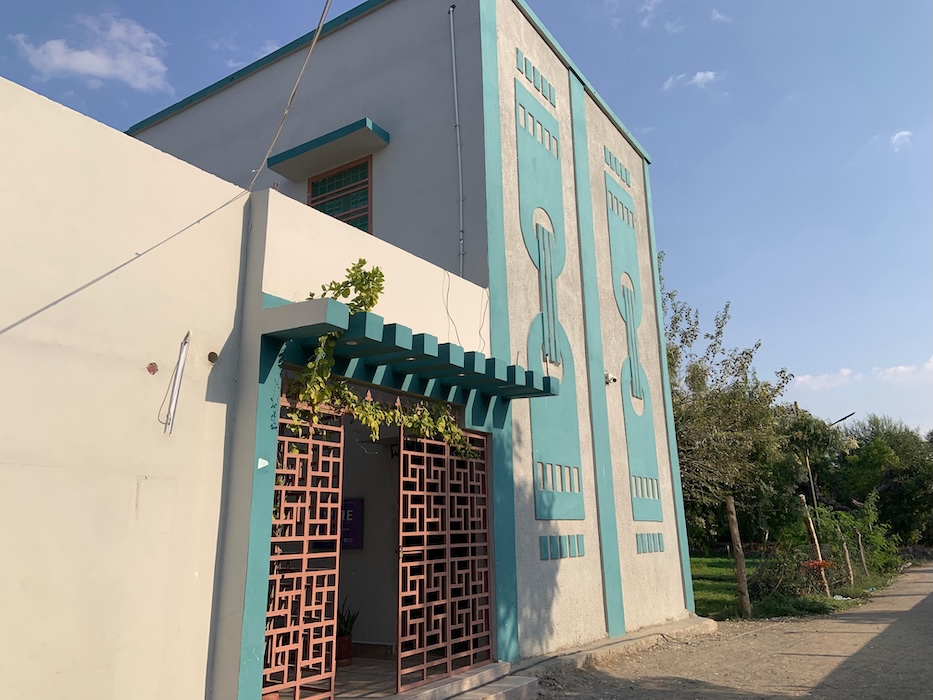
WALI matters because it is not an abstract idea. It is a physical lab in Ahmed Abad Wang, Bela, Lasbela, built so people can actually sit down, connect, learn, and practice. The place exists, the programs exist, and the public record exists as well.
The annual report describes WALI as founded in 2021 and opened in October 2022 as a solar-powered, community-led technology lab. That already tells you something important: the institution was built around continuity. It was not designed as a one-day event or a traveling workshop. It was designed as a site where repeated learning could happen.
The building is part of the model
The exterior matters because it locates the lab inside the same community the programs are meant to serve. That is different from many innovation spaces in Pakistan, which are usually urban, temporary, or disconnected from the realities of rural schooling and internet access. WALI’s building signals permanence, familiarity, and trust.
Inside, the learning rooms matter just as much. The lab has functioning computer stations, group teaching space, and the kind of environment where digital literacy, Urdu AI learning, and youth support can happen in a repeated, low-friction way. The point is not flashy design. The point is operational readiness.
Why the learning environment matters
People often talk about digital inclusion as if access ends with a device or a website. WALI shows why that is incomplete. Learners need a room, electricity, connectivity, facilitation, confidence, and enough continuity to return. A real lab gives them all of those conditions at once.
That helps explain why WALI’s programs range from digital literacy to Urdu AI to the wider ecosystem model. The building is not separate from the strategy. The building is what makes the strategy plausible.
What partners should notice in this tour
For a school, partner, or public institution, the key takeaway here is that WALI is set up for real delivery. The rooms are usable. The training spaces are visible. The community location is clear. The lab is rooted in a place that has historically been underserved and uses that position as a strength rather than a limitation.
This lab tour shows the physical space, learning conditions, and community setting that make WALI’s model possible.