Urdu AI is one of the clearest examples of how WALI's local logic can scale. The starting point is simple: many learners in Pakistan are blocked from AI education not by ability, but by language. Urdu AI responds by translating complex ideas into practical, jargon-free Urdu and delivering them through accessible teaching formats.
The 2026 WANG organizational profile describes Urdu AI as a dedicated Urdu-language AI education platform and a joint initiative of WALI and PeeL Technologies. That matters because it positions the work as more than a series of workshops. It is a structured response to a real access barrier.
What phase one already proved
The organizational profile says that phase one, covering 2024 to 2025, trained more than 1,100 participants with a 97 percent completion rate. It also records three structured YouTube courses, more than 200,000 playlist views, 256 projects submitted, and more than 20,000 additional learners enrolled in Google-sponsored AI courses.
Those numbers matter because they show multiple kinds of traction at once: live instruction, digital distribution, project completion, and wider course uptake.
Why the Dost model changed the scale of the program
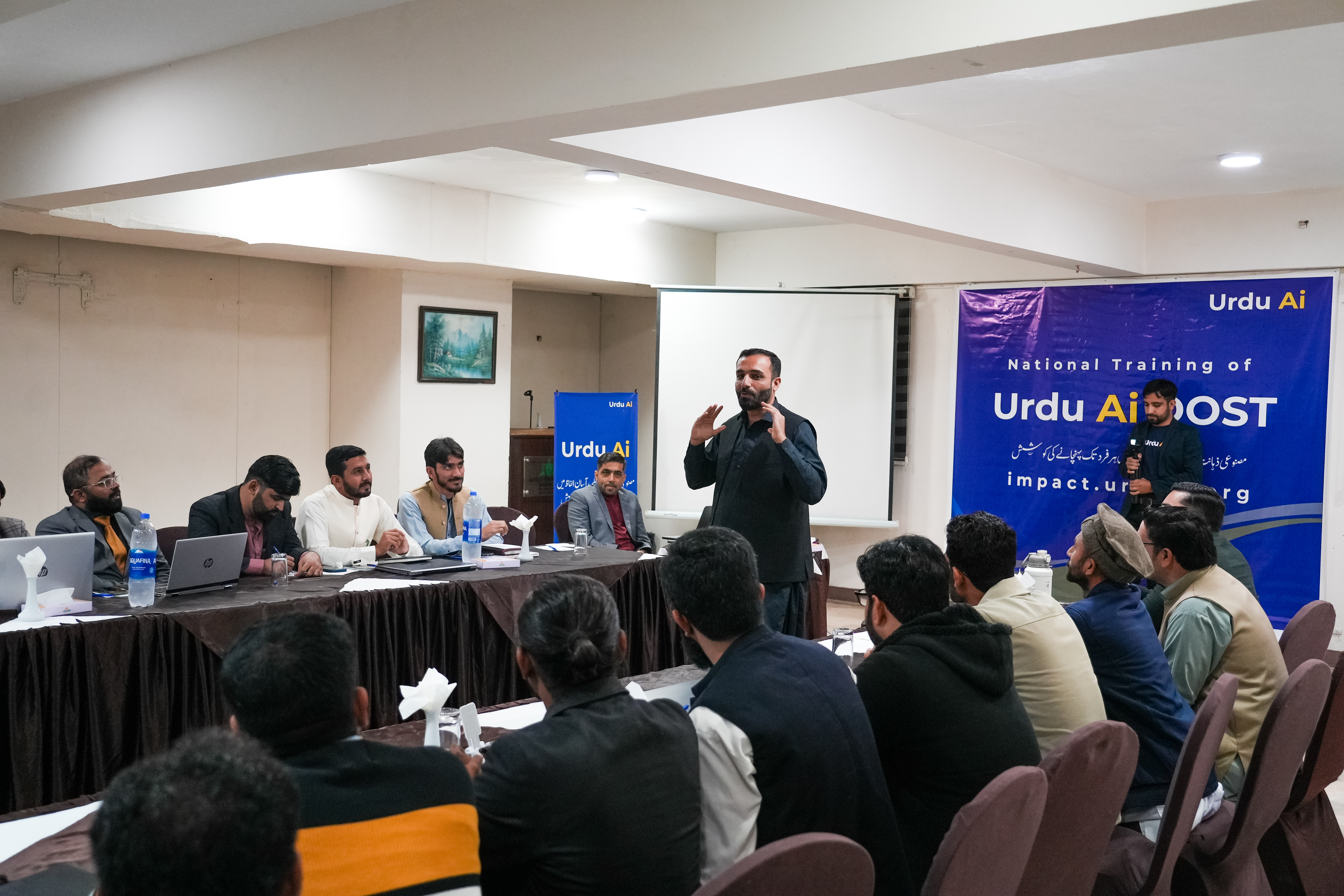
The Training of Dost material explains how Urdu AI moved from courses and workshops into a grassroots facilitator network. It says a three-day intensive trained 30 Dost from across Pakistan to lead community AI workshops in simple Urdu. Those facilitators now represent 29 districts across all four provinces and ICT.
This matters because a language-access initiative becomes much stronger when it has people on the ground, not only content online. The Dost model gives Urdu AI a human delivery network that can reach communities through trusted local relationships.
How local facilitation became visible nationally
WALI's current initiative record also points to the public Urdu AI impact site, which shows a national facilitator network and district-level presence. On that public record, Urdu AI describes 31 active Dosts across 29 districts. That gives partners something rare: a way to see a learning network publicly rather than only hearing about it in a proposal.
For a rural innovation lab, this is important. It shows that the lab is not trapped in one place. It can generate a model that travels.
What February 2026 proved
The February 2026 report shows the early rollout speed of the Dost network. In one month, the program recorded 78 training workshops across 30 cities, reaching more than 2,600 individuals. More than 1,200 of those learners were women, making inclusion one of the clearest strengths in the rollout.
The same report also highlights signed MOUs with leading universities to build faculty and student capacity. That means the program is operating at both community and institutional levels.
Why the next phase matters
The same organizational profile says phase two, covering 2026 to 2027, is funded by AVPN's AI Opportunity Fund with a USD 250,000 grant. It says WANG will deploy 30 regional facilitators to train 30,000+ learners across Lasbela, Karachi, Multan, Quetta, and Turbat, with 45 to 50 percent women participants.
That is why Urdu AI matters so much inside WALI's ecosystem. It is the strongest current example of how a rural lab can convert local insight into a public, scalable, language-first system.