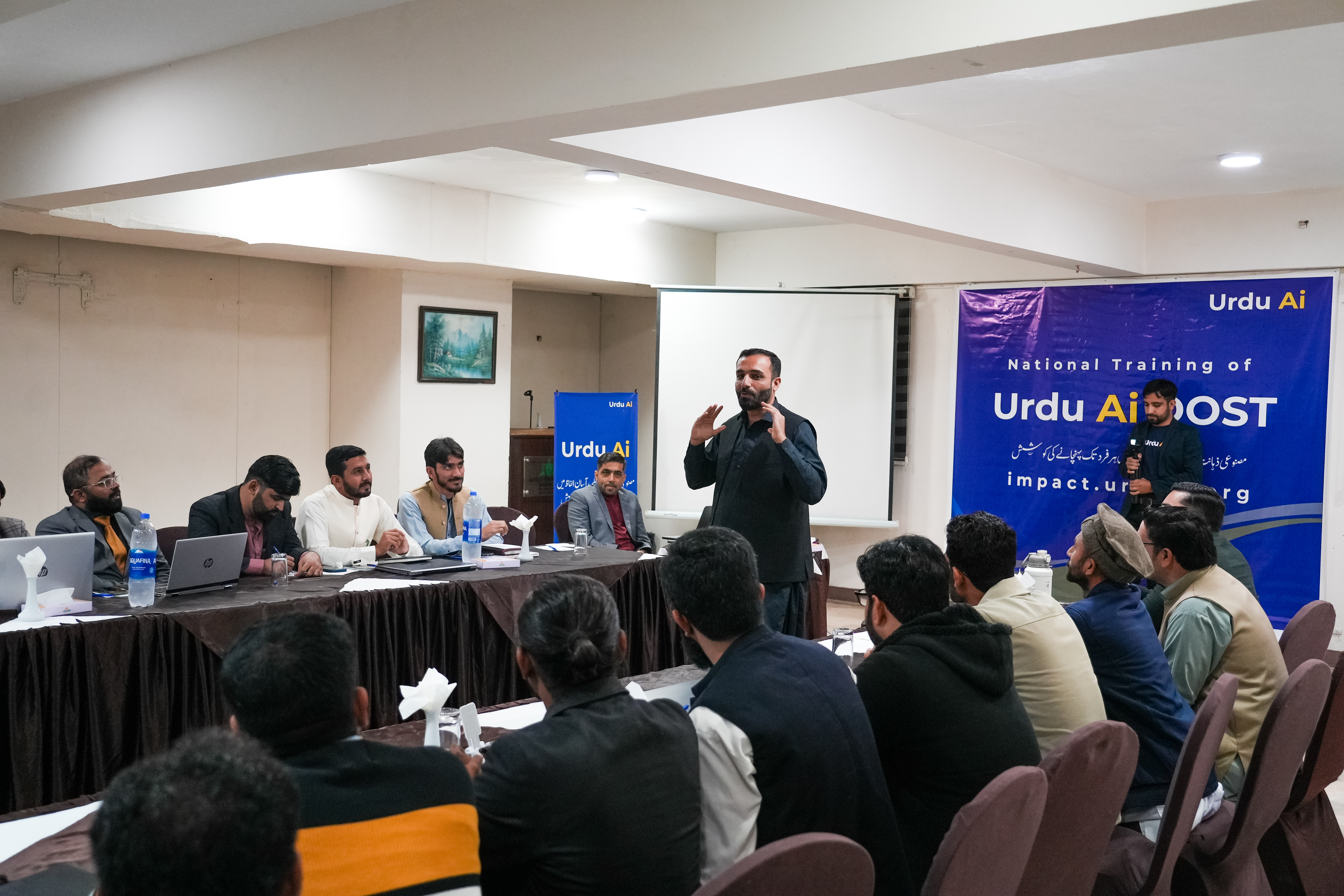
The Urdu AI Dost program matters because it solves a practical problem in a practical way. A website alone cannot take AI literacy into villages, campuses, neighborhood groups, and community halls. People do that. The Dost model turns trusted local facilitators into the delivery network for Urdu-language AI learning.
The Training of Dost presentation describes Urdu AI Dost as community-based facilitators who bring AI literacy to grassroots communities in simple Urdu. The language is important. These facilitators are not positioned as technical elites. They are presented as trusted local people who can sit with farmers, students, women, and youth, answer questions, demonstrate practical tools, and build confidence without jargon.
What the Training of Dost model established
The Training of Dost deck says the three-day intensive trained 30 Dost from across Pakistan. It describes them as community facilitators covering 29 districts across all four provinces and the Islamabad Capital Territory. The same deck positions the network against a June 2027 target of 36,000 learners.
That matters because it gives Urdu AI a visible human infrastructure. Instead of a passive audience, the program now has a named facilitator network that can hold workshops locally and repeatedly.
What happened in February 2026
The February 2026 report shows how quickly that facilitator model began moving. In one month, the report records 78 training workshops across 30 cities, with more than 2,600 individuals trained. It also says that more than 1,200 women were among those learners, making gender inclusion one of the most notable results of the early rollout.
The report frames this as a nationwide movement: 30 Dost working across all four provinces with one simple vision, making AI accessible in the language people understand best.
Why this is stronger than a top-down training model
The Dost approach is stronger because it is relational. A local facilitator can adjust the session to the group in front of them, whether that means students, teachers, women, youth, or first-time learners. That lowers the barrier to entry and makes the program easier to trust. It also fits WALI's broader logic: build systems close to the people they are meant to serve.
The February report also notes MOUs with leading universities, aimed at building faculty and student capacity. That suggests the program is not limited to community workshops. It can bridge into formal institutions as well.
Why the Dost program matters
For WALI, the Urdu AI Dost program is one of the clearest examples of how local facilitation can grow into a national impact story. It ties together language access, community delivery, women’s participation, and scalable network design. That makes it one of the strongest initiative stories in the wider ecosystem.