
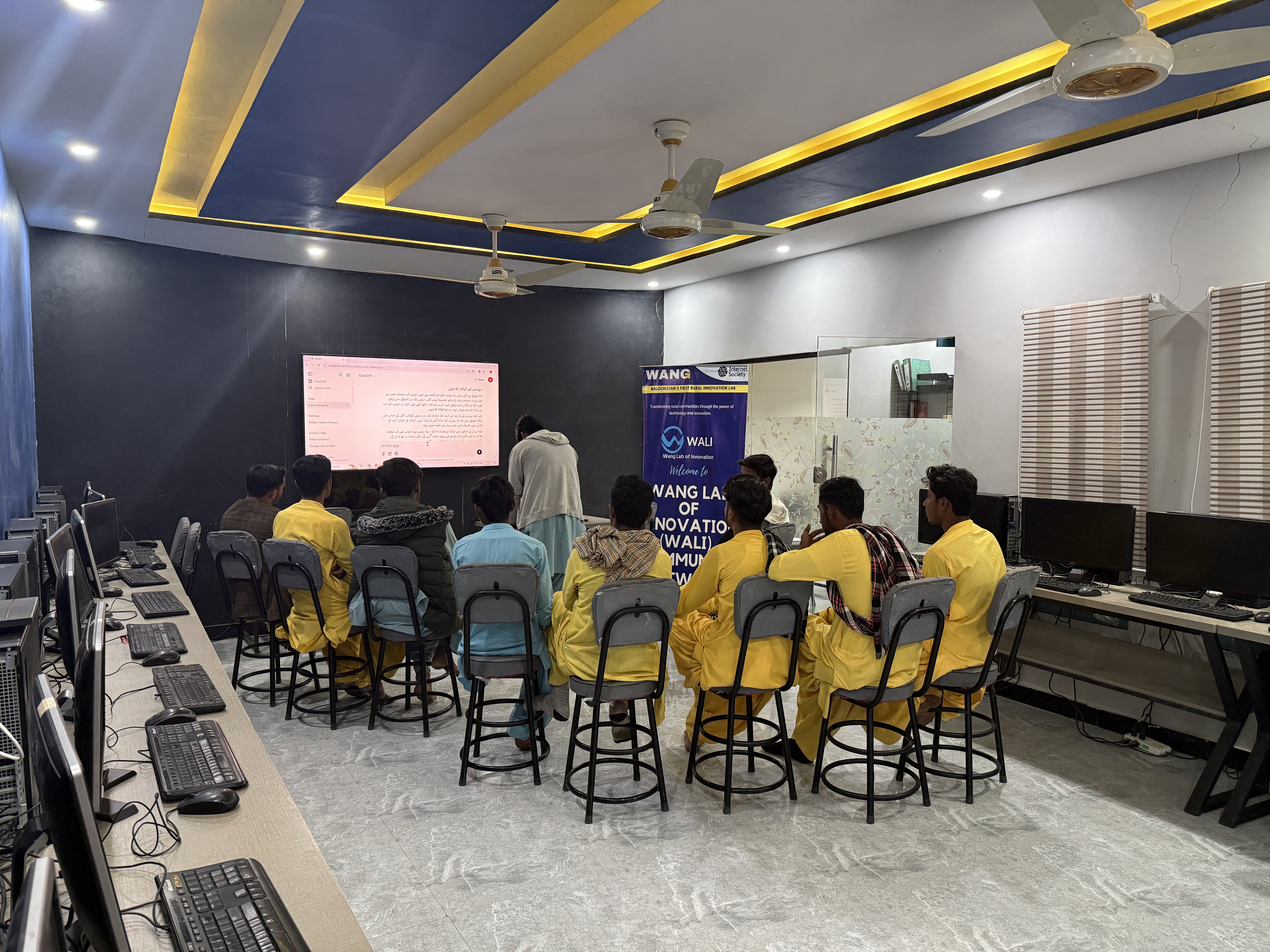
Artificial intelligence becomes exclusionary very quickly when it is taught only through English jargon or abstract technical language. WALI's 2025 annual report shows a different approach. During the year, the lab conducted six AI workshops in collaboration with Urdu AI and delivered them in simple, accessible Urdu.
That choice matters. In rural communities, language is often the first barrier to confidence. By removing it, WALI did more than teach tools. It made modern technology feel discussable, local, and useful.
What the workshops covered
The annual report lists four modules: the fundamentals of artificial intelligence, boosting productivity with AI tools, the art of prompt engineering, and the responsible and ethical use of AI. This is a strong structure because it introduces AI without separating it from day-to-day use and responsibility.
The workshops were not designed as elite technical classes. They were designed as first-entry points for people who needed a grounded explanation of what AI is and how it can be used safely and practically.
Why Urdu mattered
The report makes clear that these sessions were built to explain AI concepts in easy-to-understand Urdu. That is central to WALI's larger value. The lab is not merely importing global technology trends into a rural context. It is translating them into local language and local relevance.
This is also why Urdu AI matters within the wider ecosystem. It gives WALI a language-access pathway for emerging technology, which means AI learning can begin with comprehension rather than confusion.
From exposure to confidence
Workshops like these become more valuable when they sit inside a wider learning environment. WALI already runs digital literacy programs, youth support, and community learning sessions. That means AI exposure is not floating alone. It enters a space where learners are already building confidence with digital tools.
For partners and funders, the six workshops show that WALI can localize advanced topics without losing public-interest purpose. They show that emerging technology can be made understandable in rural Pakistan when language and facilitation are taken seriously.